AI & Discovery ·
AI, Mathematics, and a New Age of Discovery
What prime numbers, flowing air, and a centuries-old proof have to do with the things people build and use every day.
Most people meet mathematics after it has become something useful: a weather forecast, a secure message, a computer that finds a good answer quickly. Behind each of those experiences are ideas that someone first had to discover, understand, and prove.
That is what makes AI’s recent mathematical work so interesting. It raises the possibility of reaching useful understanding sooner, then giving more people a chance to build on it.
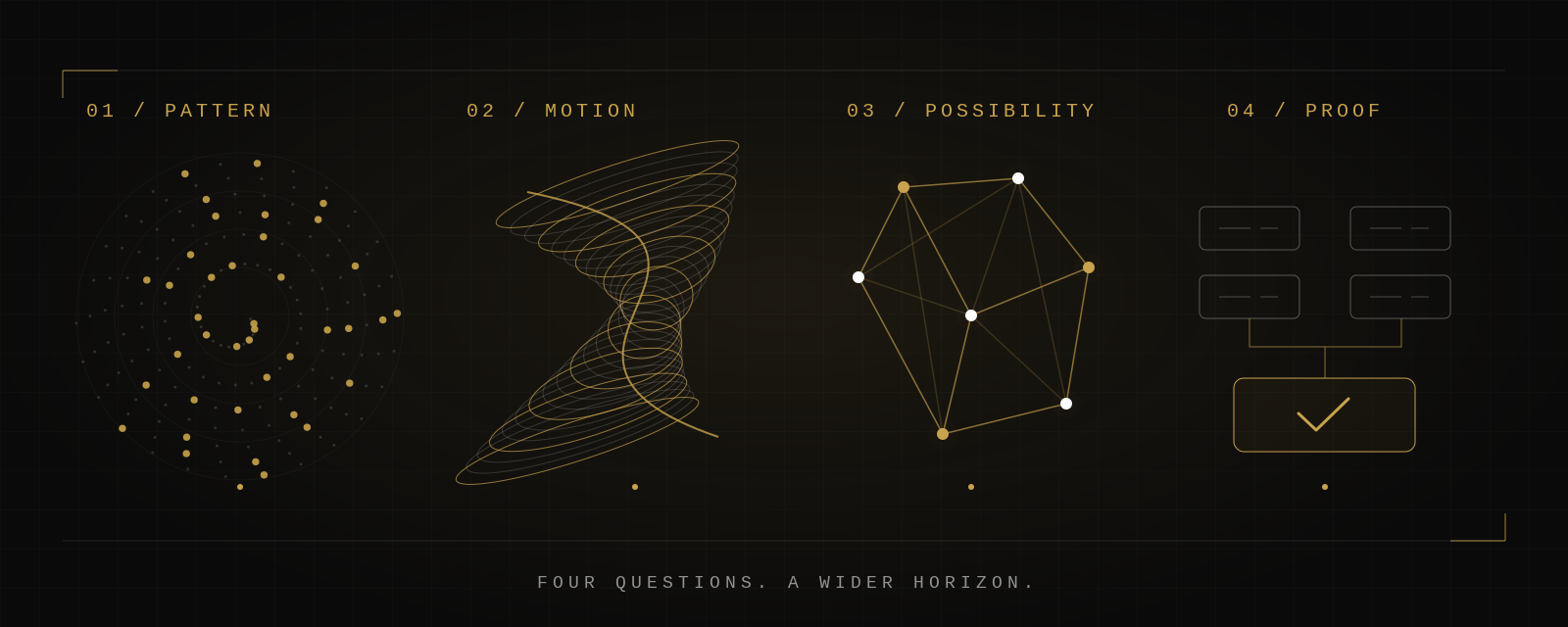
A recent Lex Fridman conversation with Ankur Moitra, Steven Brunton, and Alex Kontorovich explored four striking examples. Each matters for a different reason. Looking closely at them makes the possibilities much easier to appreciate.
Riemann: finding dependable patterns in prime numbers
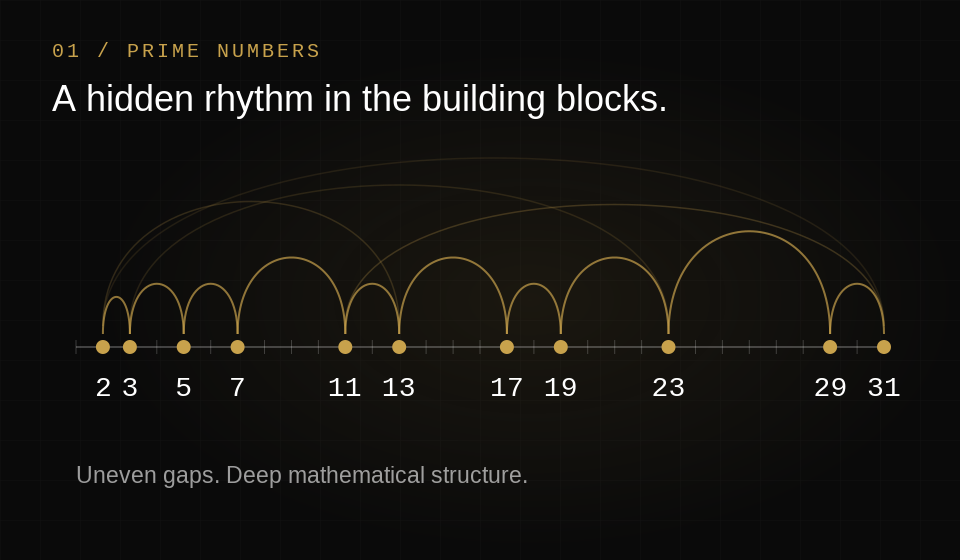
Start counting the primes: 2, 3, 5, 7, 11, 13. Sometimes they sit close together; sometimes there is a longer wait. Every whole number greater than one can be built by multiplying primes, so understanding their distribution means understanding something basic about numbers themselves.
Mathematicians already have formulas that estimate how many primes appear below a given number. The next question is how far the estimate can stray from the true count. If another proof depends on that estimate, knowing its margin of error becomes essential.
The Riemann Hypothesis describes this hidden order through a mathematical object called the zeta function. Certain points where that function equals zero encode information about how primes are distributed. The hypothesis says all its nontrivial zeros sit on one particular line, at a real part of one-half. That precise statement would give much stronger control over the error in prime-counting estimates. Clay Mathematics Institute explains this connection.
OpenAI’s AI-produced quasi-Riemann work establishes a weaker boundary, excluding zeros to the right of seven-eighths for the functions it studies. The full one-half statement remains open. In his October explanation, Terence Tao describes a concrete mathematical benefit: stronger, quantitative bounds on errors in certain estimates involving primes.
That changes what another mathematician can do. A statement that a pattern eventually settles down becomes more useful when it comes with a bound describing how quickly. That bound can become a dependable ingredient in the next calculation or proof.
The everyday connection runs through number theory’s role in computing. For example, RSA public-key cryptography uses large primes. This result’s immediate contribution is to the mathematics; turning its methods into practical computing improvements is a further opportunity. It adds knowledge to a field that already helps make secure digital communication possible.
Navier–Stokes: understanding the air around a wing
Before an aircraft wing is built, engineers can put its proposed shape into a computer and study how air moves around it. Change the shape slightly and the pressure changes. So do lift, drag, and the energy needed for flight.
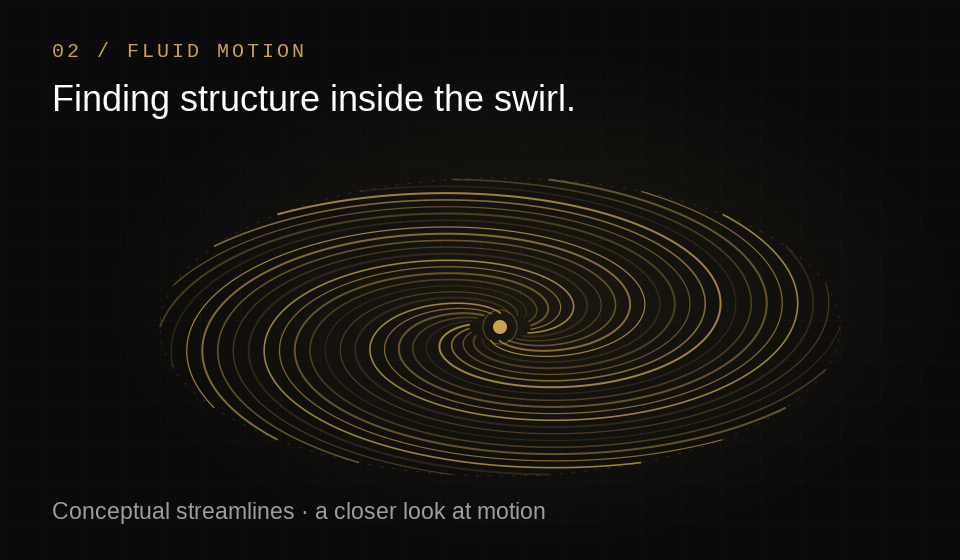
The Navier–Stokes equations help describe that moving air, just as they describe water in a pipe or the swirling wake behind a turbine. They connect a fluid’s motion to pressure, viscosity, and the forces acting on it. Computers use numerical approximations to these equations to explore designs and compare their behavior. NASA describes how this works.
One of the deepest questions concerns the equations themselves: can a smooth three-dimensional flow develop a singularity, where a quantity such as speed grows without bound in finite time? Answering it would clarify how the mathematical description behaves under precisely stated conditions. That is foundational knowledge for a field whose practical calculations depend on understanding what the equations mean.
OpenAI has proposed a construction involving a carefully chosen smooth external force. Its exact assumptions matter. An independent mathematical analysis identifies differences between the written argument and its Lean formalization, so the announced resolution remains under assessment.
The reason this area deserves attention is already visible in engineering. In an aircraft-design study, NASA used fluid simulations and optimization to reduce drag by up to 4%. Lower drag means less energy is needed for flight. Wind-farm researchers similarly simulate how the wake of one turbine affects another.
Those are existing applications of fluid science. New mathematical insights could eventually contribute through better numerical methods, more informative simulations, and comparisons with experiments. That is the route from an abstract question to a more efficient aircraft or a better-understood wind farm, and AI could help researchers explore more of it.
Unique Games: knowing how good an answer can be
Suppose a computer has a huge number of possible arrangements to choose from, and you need a good answer before a deadline. How much quality can it promise for the time available? That question sits behind a great deal of optimization.
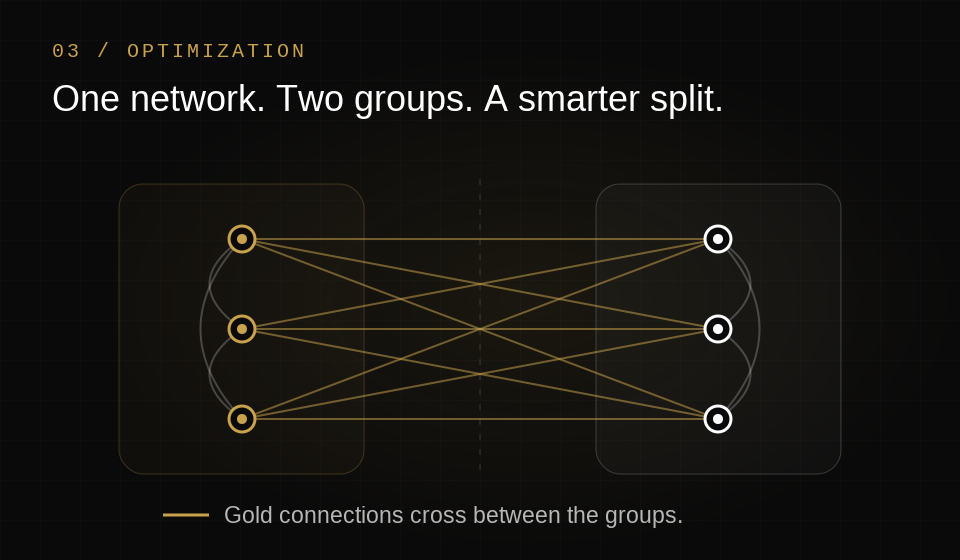
Max-Cut makes the idea easy to see. Take a network of points joined by lines. Put the points into two groups, aiming to have as many lines as possible cross between them. Moving one point changes several connections at once. The little network below has only six points, so every possible assignment can be compared. As the network grows, that approach becomes an enormous calculation.
Researchers developed an elegant way to find good cuts efficiently. The Goemans–Williamson algorithm guarantees an expected score of at least about 87.86% of the best possible score. That percentage is measured against the optimum for the network, rather than against all its connections. Max-Cut also has applications in circuit layout and statistical physics.
The Unique Games Conjecture helps explain whether that general guarantee is the best an efficient algorithm can achieve. Established research connecting Unique Games to Max-Cut shows that, if the conjecture holds and P differs from NP, no efficient general algorithm can promise a better ratio across all networks. The P ≠ NP assumption says some problems whose answers are easy to check are fundamentally harder to solve. Particular networks can still be easier.
OpenAI has published a proposed proof of Unique Games, which remains a candidate result being examined by researchers.
For someone designing algorithms, a clearer answer would help direct effort. A team could pursue methods suited to the special structure of its own network, change the computing budget, or choose a different formulation. Understanding the best general guarantee gives those choices a firmer foundation. The practical value is knowing more clearly where a clever idea can make a difference.
Fermat: turning a great proof into something others can build on
The equation 3² + 4² = 5² works. Fermat’s Last Theorem says the same pattern, aⁿ + bⁿ = cⁿ, has no positive whole-number solutions when the whole-number exponent n is greater than two.
Checking examples can suggest that a statement is true. A proof establishes why it holds throughout the entire class of numbers it describes. Andrew Wiles’s proof, completed in the 1990s, did that for Fermat’s theorem by connecting deep areas of mathematics.
Now consider what happens when a proof that complex is written so precisely that a computer can follow its logical steps. Anthropic’s AI-generated Lean formalization demonstrates that possibility at a remarkable scale. The mathematical result was already known; the new achievement is its complete computer-checkable formalization.
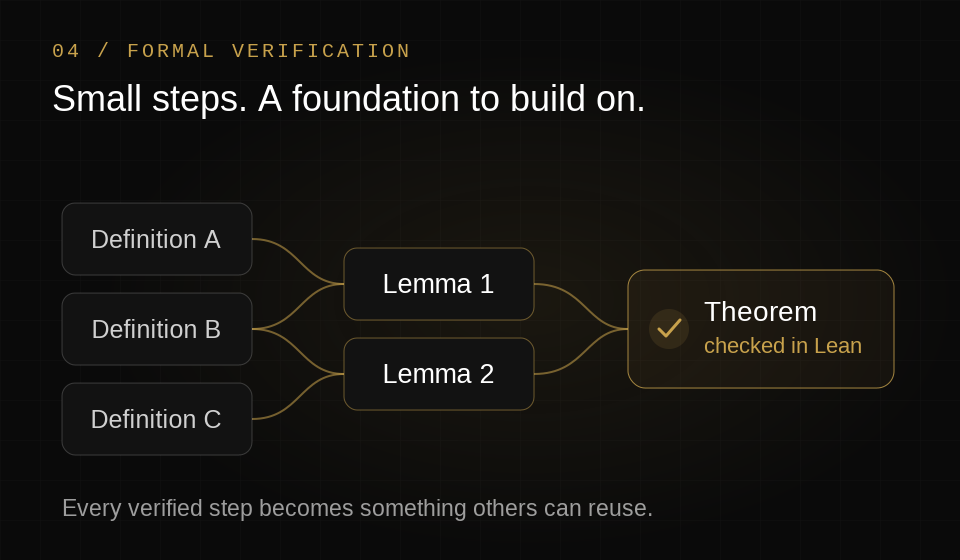
A long proof contains many smaller results. The lasting opportunity is to organize checked results into libraries that future researchers can use. Someone pursuing a new idea could start with established pieces, combine them, and have the checker follow how they fit together. The released Fermat repository is a research artifact; developing reusable, maintained libraries from work of this scale is part of the next chapter.
There is a practical connection beyond research mathematics, too. Lean supports verification of software, hardware, and protocols. A developer can express a precise property of an algorithm and seek a proof that it holds for every input covered by the statement. Making long proofs easier to construct could make that approach accessible to more teams.
The promise is more reasoning that people can inspect, check, and reuse. A researcher gains a stronger starting point for discovery. A developer gains another way to establish that an important calculation behaves as intended. AI’s ability to help with the detailed work could make both possibilities much more approachable.
How understanding becomes useful
A mathematical advance reaches everyday life through many people’s work. A new estimate becomes part of another proof. An insight about fluid motion becomes a candidate method, then a simulation tested against measurements. A verified result becomes something another researcher can safely build on.
AI could help at several points in that process: exploring possible arguments, translating reasoning into a checkable form, and helping people understand unfamiliar ideas. Each contribution becomes more valuable when others can explain it, examine it, and put it to work.
That is the exciting prospect behind these four stories. More questions could become tractable. More useful ideas could travel between fields. And more people could have the support to take an idea from something they wonder about to something they can create.
Sources
Research status checked October 29, 2026. These original publications, expert analyses, and technical references support the explanations above.
- The conversation: Lex Fridman Podcast #503 transcript.
- AI mathematics and review status: OpenAI’s research repository, its result catalogue, and UT Austin’s account of Dana Moshkovitz’s assessment.
- Prime numbers: Clay Mathematics Institute on the Riemann Hypothesis, Terence Tao’s October 19 mathematical exposition, and NIST on number theory and cryptography.
- Fluid motion: OpenAI’s Navier–Stokes announcement and Bastounis, Circelli, and Hansen’s independent analysis of its formalization.
- Engineering applications: NASA’s explanation of the Navier–Stokes equations, NASA’s aircraft-design optimization study, and Sandia’s wind-turbine interaction simulations.
- Approximation algorithms: Goemans and Williamson’s original Max-Cut paper and Khot, Kindler, Mossel, and O’Donnell on Unique Games and approximation guarantees.
- Formal verification: Anthropic’s Fermat announcement, the published proof and checking instructions, and Lean’s official verification FAQ.